

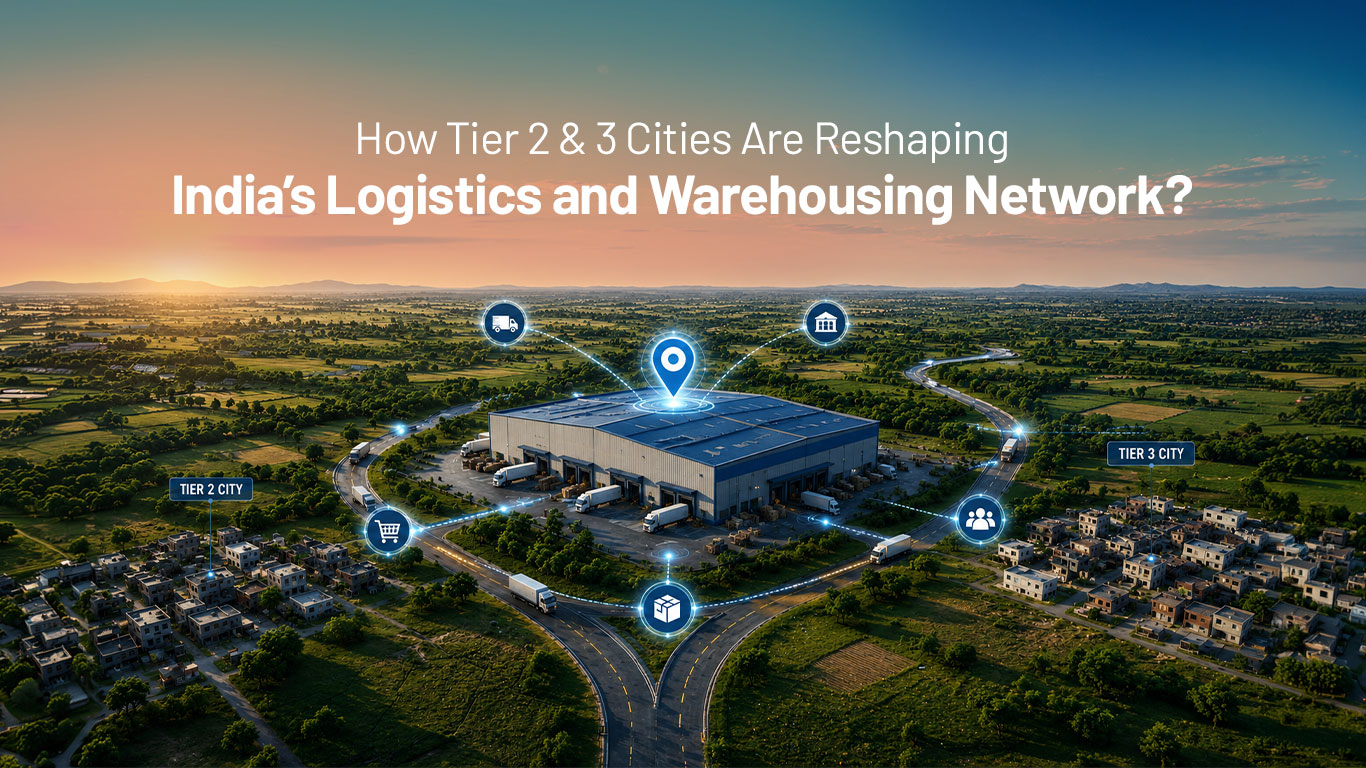
How Tier 2 & 3 Cities Are Reshaping India’s Logistics and Warehousing Network?
Introduction
India’s next phase of growth is not unfolding in its largest cities. It is spreading across smaller, less saturated markets where demand is becoming more distributed. This shift is bringing Tier 2 and Tier 3 cities into focus, not just as emerging consumption centres but as critical nodes in how goods are produced, stored, and delivered.
At Fourmativ, we see this as a systems transition. As demand spreads across smaller cities, logistics infrastructure must evolve from centralised models into distributed, integrated networks that can operate efficiently at scale.
Tier 3 Cities Are Changing How Demand Is Distributed
The rise of Tier 2 and Tier 3 cities is closely linked to how digital consumption is rising across the country. India’s e-commerce market is projected to reach USD 350 billion by 2030 (Invest India), with a significant share of online buyers coming from smaller towns.This signals a structural shift in how goods move across the country. Demand is no longer concentrated within a few metropolitan clusters. It is becoming increasingly fragmented across regional markets, requiring supply chains to become faster, more distributed, and significantly more responsive.
Why Traditional Supply Chains Are No Longer Enough
For years, logistics systems in India were designed around scale through centralisation. Large warehouses positioned near metros and big cities served wide regions, optimising inventory but not necessarily speed. This model held up when demand was concentrated in urban centres.
That reality has shifted. As delivery expectations shrink from days to hours, inventory can no longer remain concentrated in a handful of metro-based warehouses. As consumption surges across Tier 3 cities and beyond, the conventional hub-and-spoke model can no longer keep pace. Businesses must move closer to their end-users, replacing a single dominant hub with multiple, strategically located nodes.
This evolution is not optional, it is operationally necessary.
A decentralised approach improves:
- Delivery timelines
- Last-mile efficiency
- Overall network responsiveness
It also enables businesses to handle fluctuating regional demand more effectively.
How Fourmativ Is Redefining Logistics Across Tier 3 India
At Fourmativ, we aim to bring coherence to India’s logistics ecosystem. Logistics is most efficient when it operates as a system, not as standalone assets. As supply chains expand into Tier 2 and Tier 3 cities, the focus is not just on extending reach, but on building infrastructure that can perform consistently across different layers of demand.
Our model is anchored in three integrated offerings, each addressing a critical part of the logistics ecosystem:
-
FOURWRD – Momentum That Moves India Forward
FOURWRD is Fourmativ’s flagship platform that develops large-scale multimodal logistics parks with integrated road, rail, and port connectivity on a single, compliant infrastructure, while also enabling multiple operators to co-exist and scale with confidence. These high-capacity hubs are designed to anchor regional movement, while expanding connectivity to national and international industrial corridors.
-
FOURCI – The Network That Links Regional Hubs
FOURCI caters to institutional-grade warehousing hubs developed across new frontiers, regional markets identified early, enabling consistent operations, flexible expansion, reliable distribution, and scalable growth.
-
FOURUN – The Pulse of Instant Fulfillment
FOURUN is centred around urban and regional warehousing solutions. It brings distribution closer to consumption by enabling flexible, strategically located facilities across Tier 1, Tier 2, and Tier 3 cities. As fulfilment cycles continue to compress, proximity to demand is becoming a competitive advantage rather than just an operational preference. These environments are designed to support e-commerce warehouse operations, faster fulfilment cycles, and evolving last-mile expectations.
Conclusion
The future of logistics in India will depend less on proximity to metropolitan cities and more on the ability to build interconnected infrastructure across emerging demand centres.Tier 2 and Tier 3 cities are no longer peripheral to India’s growth, they are becoming essential nodes in a distributed logistics system. As demand decentralises, the need for integrated, multi-layered infrastructure becomes critical. At Fourmativ, our approach is built to enable this shift through connected, system-driven logistics networks.
Source: https://www.investindia.gov.in/sector/retail-e-commerce
Comments (0)
No comments yet. Be the first to comment!