

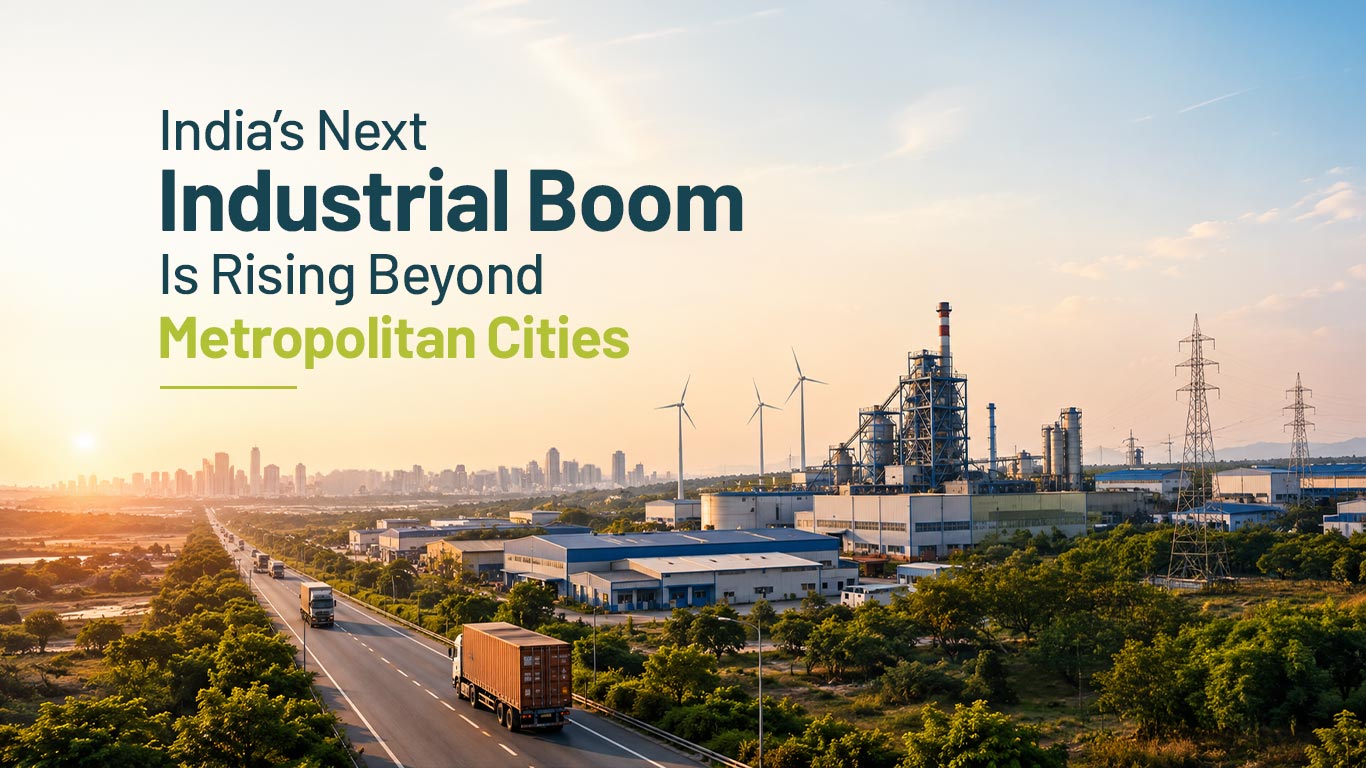
India’s Next Industrial Boom Is Rising Beyond Metropolitan Cities
Introduction
Historically, India’s industrial growth has always been anchored around its largest cities. Proximity to ports and access to established infrastructure turned metropolitan cities into centres for manufacturing and logistics. That model is now changing.
As industrial activity moves deeper inland and supply chains expand across regions, industrial corridors are extending beyond traditional hubs. They are becoming more distributed, multi-regional networks that support a wider geography of growth. This shift is also redefining how Tier 2 and Tier 3 cities infrastructure is planned and built within India’s next phase of development.
The Shift to Multi-Nodal Networks
Industrial corridors were once designed as connectors between production hubs and ports, with metropolitan cities such as Mumbai, Delhi, Kolkata, Chennai, Bangalore, and Hyderabad acting as central anchors. Today, they are becoming multi-nodal networks.
Emerging regions in Tier 2 and Tier 3 cities along these corridors absorb significant industrial growth by offering:
- Cost efficiency
- Scalability
- Strategic access
They are becoming critical to how corridors now function. They not only enable smoother movement, but also compress transit timelines and reduce logistics costs at scale.
FOURWRD Indore: Positioned for Scale and Connectivity
FOURWRD Indore, Fourmativ’s flagship Multi-Modal Logistics Park was envisioned and planned with this shift in mind.
Located at the heart of one of India’s fastest-growing industrial clusters, FOURWRD Indore offers a unique zero-mile advantage. It provides equidistant reach to northern, western, and southern Indian markets. This strategic positioning of the site helps businesses move goods across the country faster and at a lower cost.
As one of India’s fastest-growing Tier 2 cities, Indore is supported by a dense industrial ecosystem spanning Dhar, Pithampur, Dewas, and Ujjain. Strengthened by the Indore-Pithampur Economic Corridor, this region functions as the manufacturing and logistics backbone of Central India.
Built as Infrastructure, Operated as a System
FOURWRD Indore is not built as a standalone asset, but as part of a larger movement ecosystem. It enables multimodal cargo flow at scale with:
- Rail-linked infrastructure
- Direct highway access
- Dry port capabilities connecting to major ports
This reduces reliance on single transport modes and improves turnaround time across supply chains.
Conclusion
Industrial corridors in India are no longer anchored to metropolitan cities. They are evolving into distributed systems powered by strategically located nodes. Tier 2 cities like Indore will be at the forefront of this transformation, with tier 2 cities infrastructure playing a key role in enabling efficient logistics. FOURWRD Indore by Fourmativ is a step in that direction, filling a critical gap in Central India’s logistics network.
Comments (0)
No comments yet. Be the first to comment!