

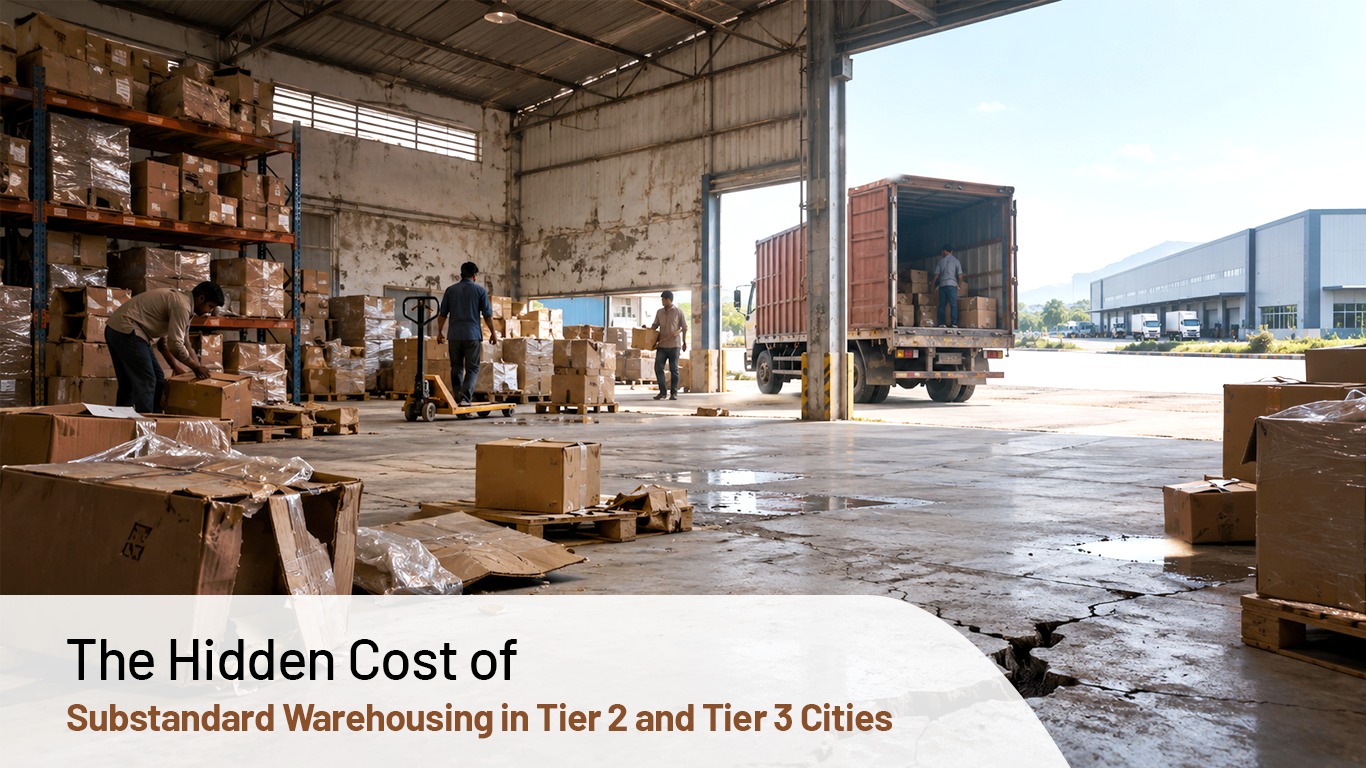
The Hidden Cost of Substandard Warehousing in Tier 2 and Tier 3 Cities
Introduction: When Lower Rent Becomes a Costlier Choice
Businesses expanding into Tier 2 and Tier 3 cities often prioritise factors like rent, location, and immediate availability. Lower monthly rent can appear commercially attractive, especially when entering a new, emerging market. However, in reality, the quoted rent represents only one component of the warehouse’s actual cost. Poor infrastructure can create recurring expenses through product damage, inefficient movement, repairs, and operational modifications. Ultimately, warehouse decisions should be based on total operating value, not rent alone.
Tier 2 and Tier 3 Cities Need Infrastructure That Can Match Their Growth
Logistics networks are expanding beyond metropolitan hubs due to a shift in demand and consumption patterns in regional areas. Tier 2 and Tier 3 cities such as Indore, Kochi, Ajmer, have started to function as regional distribution and fulfillment centres. As per a study conducted in 2024, 12 of India’s Tier 2 and Tier 3 markets held approx. 95 million sq. ft. of warehousing stock. This accounted for 18.7% of stock across a total of 20 markets, including Tier 1 cities. Their warehousing stock has grown fourfold since 2017. Yet, Grade-A facilities constituted only 30% of inventory in these emerging markets, revealing a significant quality gap. (Source: JLL India, “India’s warehousing boom: Tier II-III cities drive 100M sq. ft.”, 2025.) This makes access to institutional quality warehousing solutions as important as access to space itself.
The Difference Between Rent and Total Occupancy Cost
A substandard warehouse in a Tier 2 or Tier 3 city that looks cost-effective on paper can be far more expensive once operations begin. Beyond monthly rent, expenses catering to repairs, maintenance, utilities, material handling, labour, safety upgrades, inventory loss and downtime add to total occupancy cost. Businesses may also incur capital expenditure to make a basic facility operational, such as installing fire systems, repairing floors, creating docks, or strengthening electrical infrastructure. Such costs often emerge once the lease is signed.
Five Costs That May Be Hidden in a Substandard Warehouse
1. Product Damage and Inventory Loss
Your product is at the core of your business. Water ingress, dust, pests, poor ventilation, and unsuitable storage conditions associated with a substandard warehouse can damage inventory. This leads to not just financial losses but also increased customer complaints, returns, and affects reputational risk.
2. Poor Flooring and Material-Handling Inefficiency
Uneven or deteriorating floors can restrict forklift movement, slow loading, and increase equipment wear. Grade-A floors are designed around load capacity and continuous material movement. Frequent repairs can interrupt operations and add maintenance cost.
3. Inefficient Layouts and Limited Racking
Inadequate clear height, poorly planned columns, and narrow circulation areas reduce usable capacity. Businesses may rent more floor space while storing less inventory. Layout also affects picking distance and labour productivity. Academic research estimates that order picking can account for as much as 55% of warehouse operating cost, making layout efficiency commercially significant. (De Koster, Le-Duc and Roodbergen, “Design and control of warehouse order picking: A literature review”, 2007.)
4. Compliance and Safety Exposure
Inadequate firing systems and exits, poor electrical infrastructure and non-compliant storage arrangements can create logistical and legal risks. India’s warehousing standards cover considerations like fire safety, structural design, material handling, security, and sustainability. Retrofitting these systems after a warehouse has been occupied can disrupt operations and add to unplanned expenses.
5. Recurring Modifications
Growing businesses may need to constantly upgrade and add docks, change racking, and reinforce flooring. Such modifications consume capital without always creating a scalable long-term facility.
Build For Long-Term Performance, Not Short-Term Savings
In fast-growing Tier 2 and Tier 3 cities, businesses should not have to choose between local access and dependable infrastructure. FOURCi provides Grade-A, built-to-suit warehouses across 20–40-acre developments, equipped with:
- Modern flooring
- Fire and regulatory compliance
- Modular upgrades
- Plug-and-play infrastructure
These future-ready warehousing solutions reduce operational uncertainty, enable consistent performance and allow businesses to scale without recurring modifications or infrastructure compromises.
References:
1. JLL India. India’s warehousing boom: Tier II–III cities drive 100M sq. ft. 2025. Available at: https://www.jll.com/en-in/newsroom/indias-warehousing-boom-tier-ii-iii-cities-drive-100m-sq-ft?
2. De Koster, Le-Duc and Roodbergen. Design and Control of Warehouse Order Picking. 2007. Available at: https://www.sciencedirect.com/science/article/abs/pii/S0377221706006473?
Comments (0)
No comments yet. Be the first to comment!